GCSSD Board hears results of Feasibility Study
GCSSD Board hears results of Feasibility Study
By Logan Watson
Representatives from The Lewis Group were on hand at last Tuesday night’s 2.5-hour meeting of the Gibson County Special School District’s Board of Education to discuss the results of the district’s oft-maligned Feasibility Study, which began in September 2025.
The 132-page study includes a facility assessment for each of the nine schools in the GCSSD, providing information on four areas: building envelope and structure, health and safety, accessibility and general conditions.
“It’s a lot,” said Dr. Brian Bell, Educational Planner for the organization. “It’s going to take a while to digest.”
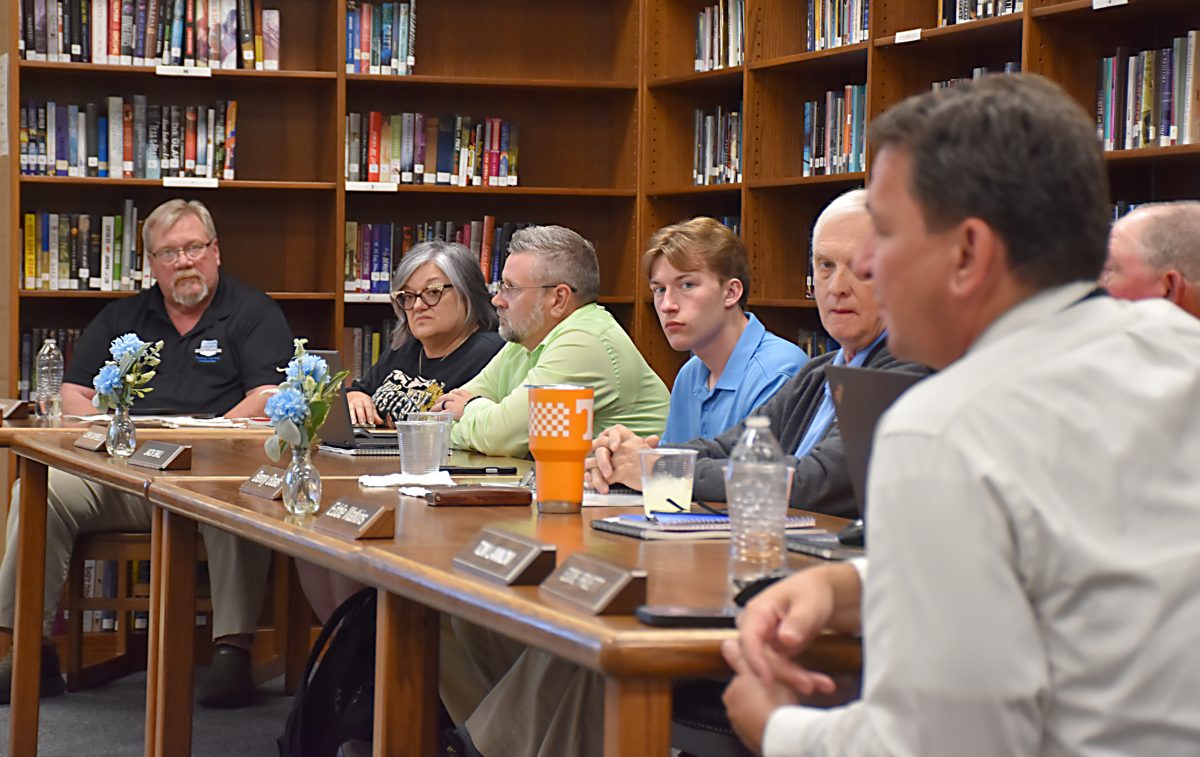
GCSSD Board members discuss options for providing more Career Exploration and STEM opportunities for middle school students in the Northern part of the district.
Todd Brang, Principal of The Lewis Group, said that the buildings were for the most part in the shape that would be expected based on their age. He noted an additional safety concern at Dyer School based on the fact that students must cross the street between the two buildings multiple times per day.
The study also indicated a slight increase in the population of Gibson County over the last 10 years, but a slight decline in the growth rate within the GCSSD’s boundaries. Project Coordinator Lily Loveday stated that the schools in the Northern part of the district have stagnated however with projected negative growth rates across all schools, with the exception of South Gibson County High School. Loveday said that the projected growth at SGCHS did not indicate an urgent problem that needed to be addressed, because of the declining growth rates at SGC middle and elementary schools.
Dr. Bell informed the Board that several of the schools have areas that are not currently being utilized. While that means that there is room for growth at those schools should student populations increase, it also means that there are classrooms sitting empty. South Gibson County High School is closest to the ideal utilization rate.
“We took this job very seriously,” Dr. Bell said. “Any time you make recommendations for the direction of schools, it’s a big responsibility. We studied demographics, we studied growth projections, we studied school enrollment projections, we looked at your facilities, utility rates, educational outcomes, educational considerations…but overriding it all, we knew that the schools in your community are more than just schools. They’re sometimes the heart of your community and they’ve been there for generations. These are generational schools. As we went through the process of putting our recommendations together, we felt the weight of that. But we also wanted to let our data lead where we were going. I don’t think we would be doing your students or your communities justice if we let our sentiment about small schools and communities override the evidence that was presented.”
To that point, Dr. Bell presented two major recommendations to the Board:
Option One – the creation of a new, comprehensive, PreK-8 school, combining Kenton, Rutherford, Dyer, Yorkville and Spring Hill for between 1,080 and 1,100 students. The school would be located in a five square mile area bordered by Highway 45, Hopewell Road and Old Dyersburg Road. The centralized area would minimize commute times for students. The recommendation also includes a redistricting that would send approximately 28 students from the Spring Hill area to the South Gibson County schools. The Board would also have the option of not consolidating Kenton School and either leaving it unchanged or expanding it to a PreK-8 school.
Bell said that the larger school would allow for more educational opportunities for students, but would cost the small class sizes and the personal connections provided by small community schools.
“Those are things that the Board of Education is just going to have to weigh out,” Dr. Bell said.
Option Two – A consolidated PreK-4 school and a consolidated middle school for grades 5-8 located at Rutherford. The middle school would require some additions to the Rutherford School building. The Board would also have the option to transform Kenton School into a system-wide CTE facility for middle school students.
The Board also has the option to leave the schools as they are.
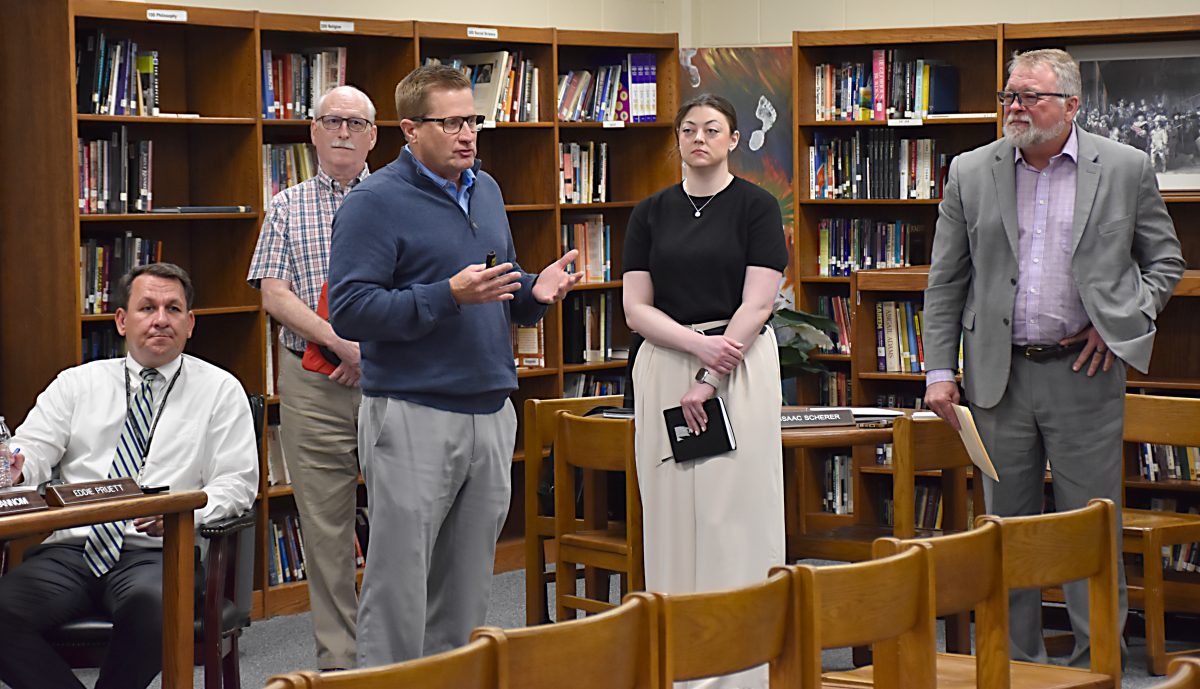
Representatives from The Lewis Group discuss the findings of the Feasibility Study.
There was also some discussion about projected costs should the Board choose to act on either of the plans, ranging from roughly $2M for classroom additions to as much as $73M for a new consolidated PreK-8 school, as well as possible security improvements at each school, which was also examined in the feasibility study.
Board members discussed the matter of a “community impact study,” which would examine the impact a school closure would have on the community, which they felt had been agreed to but was ultimately not included in the study.
Board members agreed that they would like to take the data back to the individual school communities before they made any decisions. Board members and Principals at each of the schools will create a committee to discuss the results of the study with members of the community and bring their input back to the Board.
Student School Board member Jack Ball impressed with his suggestion that the size of the committees reflect the size of the school communities and that students also be asked about their thoughts on the matter.
“They’re the ones living the life that you’re changing, so I think they have a valid say in how their education is impacted,” Ball said.
The committees will meet before the August school board meeting.
In the coming weeks, Gibson County Publishing will examine the results from each school included in the feasibility study. Other items discussed at the meeting, including the accomplishments of Career and Technical Student Organizations, will be covered in a separate article.
Other Business
The Board approved a plan that would provide Career Exploration and STEM opportunities for students at Yorkville and Spring Hill schools without impacting schedules at the other schools. The district will be adding a Computer Applications teacher position, which will be funded through the Innovative School Model Grant. The GCSSD will have to fully fund the position for the 2027-28 school year. Director Pruett proffered a second option, which would have resulted in the creation of four separate positions, increasing the cost to the district.
The Board approved a $2,000 stipend for teachers working in extended learning classrooms and a $1,200 stipend for extended learning Teacher Assistants. Director Pruett said that he hoped the stipend would help recruit and retain staff in a demanding area.
The Board also voted to name the GCSSD’s virtual school the “GCSSD Virtual Innovation Academy.” It will be referred to as the “Innovation Academy” in shorthand.
The Board voted to amend the budget for $25,000 in Project Raise grant funds. The money will go toward stipends for school counselors. The district also received a $69,000 grant for cybersecurity. The funds will be used to purchase items that were included in the 2026-27 budget, which will save the district money next year. A grant has also been awarded to the GCSSD for the 2026-27 school year. The teacher will alternate between Yorkville and Spring Hill schools each year.
The Board approved a $26,939 bid for a walk-in freezer at Yorkville School, as well as the Board meeting and agenda schedule for the 2026-27 school year.
The Board approved new EPSO and Honors courses for the upcoming school year.