
Humboldt mourns passing of Coach Ronald Abernathy
by Seth Wilkerson
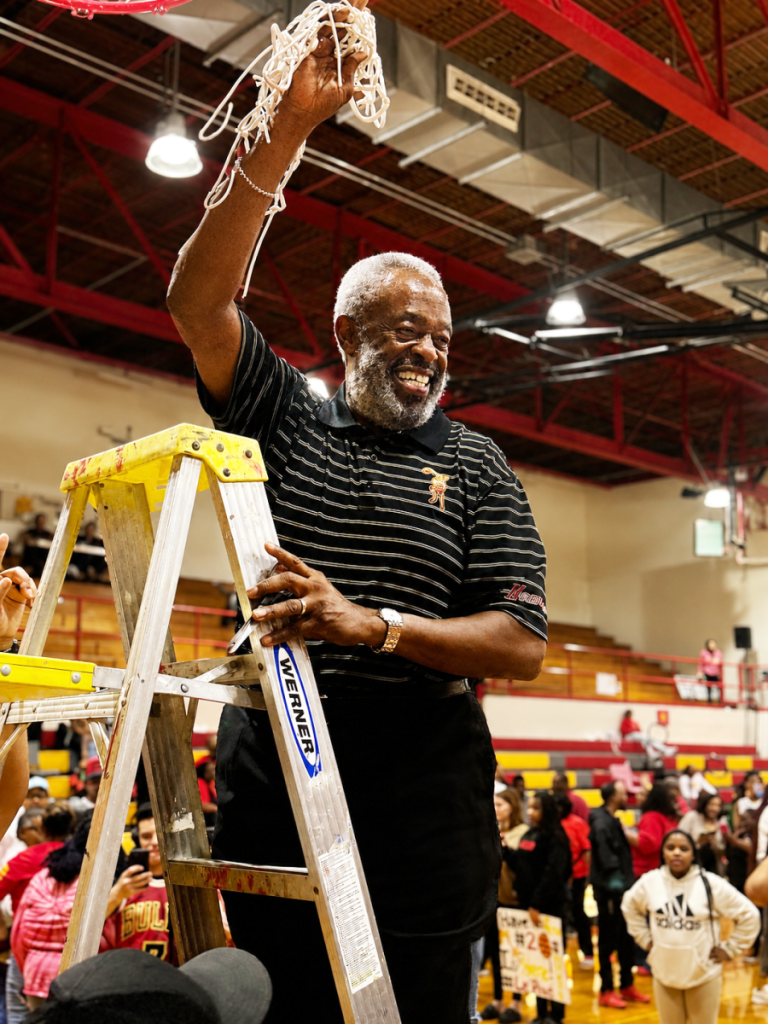
Some coaches leave behind wins. Some leave behind trophies, banners, and record books that force the next generation to measure itself against numbers that may stand for years. Ron Abernathy left all of that. But if you knew him, or played for him, or worked beside him, or simply watched one of his teams carry itself the way he believed a team should, then you understand that the numbers were never the biggest part of the story. The true measure of Coach Abernathy was always in the people he shaped and the standards he left behind. He died on June 24, 2026, at 75, only a few months after retiring from Humboldt High School following a 12-year run that produced more than 200 victories and deepened one of West Tennessee’s proudest basketball traditions.
That is the easy version of the résumé. It is the part you can stack neatly into a paragraph, the part that belongs in a media guide or on a plaque. But it does not come close to explaining why his passing hit Humboldt the way it did, or why so many people from Baton Rouge to Jackson to Louisville reacted as though they had lost not just a coach, but a piece of themselves. Abernathy had that kind of reach. He could be demanding without being distant. He could correct you sharply and still leave no doubt that he believed in you. He could push players to exhaustion and, somehow, have them grateful later. That kind of authority cannot be faked. It is earned over years, practices, bus rides, honest conversations, and the quiet consistency of showing people exactly who you are.
Before he became part of Humboldt’s red-and-gold identity, Abernathy had already built a life in basketball that stretched far beyond any one gym. Born in Louisville in 1950, he graduated from Morehead State, later earned a master’s degree from LSU, and first made his name as a teacher and coach at Shawnee High School. In 1976, he was recognized as Teacher of the Year there and was a runner-up for Kentucky High School Coach of the Year. His record at Shawnee was exceptional, and more importantly, he had already begun to show the trait that would define his career: a gift for developing young players while demanding that they grow as young men too.
One of those Shawnee players was Durand “Rudy” Macklin, who would go on to become one of the most important figures in LSU basketball history. And that relationship changed more than one life. When Dale Brown came recruiting Macklin, he also discovered the coach who had helped shape him. Brown later remembered Abernathy as “the sweetest, nicest man,” “well-dressed,” “a very good coach,” and, maybe most memorably, “a spark of positivity.” Macklin remembered something else: the standard. He remembered the practices, repetition, insistence on detail, and the demand to run it again until it was right. It is one thing to be remembered fondly. It is another to be remembered for making people better. Abernathy was both.
At LSU, Abernathy became a barrier-breaker and a builder at the same time. He joined Brown’s staff in 1976 and was identified by LSU as the program’s first African American coach. But what made his place in Baton Rouge so significant was that he did not simply arrive to make history; he arrived to help transform a program. During his time on staff, LSU grew into a national power, producing 13 non-losing seasons, 11 straight postseason appearances, nine NCAA Tournament trips, Final Four runs in 1981 and 1986, three SEC championships, and the program’s only SEC Tournament title in 1980. Those years helped establish LSU as a real power, and Ron Abernathy played a significant role in that climb.
That period of LSU basketball still stands as one of the high points in the program’s history, and Abernathy’s fingerprints were all over it. He recruited, scouted, taught, pushed, and developed players. Macklin was one. So were DeWayne Scales, Willie Sims, Ethan Martin, Leonard Mitchell, and others named by LSU in its remembrance of him this past week. Before he left Baton Rouge for his first Division I head coaching opportunity, he also helped finish the recruiting of Shaquille O’Neal, who would become one of the most recognizable players in basketball history. Johnny Jones, who played under Abernathy and later coached alongside him, remembered a man who stressed pride, respect, effort, and representing family, team, and school the right way. That recollection followed Abernathy long after the LSU years ended.
He left LSU to become head coach at Tennessee State, then later worked in Louisiana, served as a social worker in Florida, coached again at River Ridge High School, and in 2006 resurfaced in Tennessee at Lane College, where he became athletic director and the winningest basketball coach in school history. In 2012, he was teaching kindergarten at St. Mary’s Catholic School in Jackson while also serving as athletic director and coaching middle school basketball. There is something revealing in that path. A lot of coaches talk about loving the game. Ron Abernathy kept finding ways to live it, whether the stage was the SEC, a small college, a middle school gym, or a high school trying to protect a proud tradition.
That next stop was Humboldt, and in many ways it became the most personal chapter of all.
When Humboldt hired Abernathy in 2014, the school was not handing its program to a placeholder. It was bringing in a coach with deep experience, a serious reputation, and a long understanding of what winning programs look like. In 2019, when he was named TSSAA Boys Basketball Coach of the Year for the entire state, administrators praised not just his basketball acumen but the way he worked with players as students and young men. Dr. Versie Hamlett (former Humboldt School Superintendent) said he taught respect and academic accountability along with the game. George Yarbro (Humboldt City Schools Athletic directed) said his greatness was found not merely in his basketball background but in the lives changed through coaching. Those comments ring differently now because they read less like ceremonial praise and more like a clear description of the role he came to occupy in Humboldt.
He won immediately, but winning alone never explains why a coach becomes part of a place.
Humboldt has always taken basketball seriously. It is not a town that treats the sport as background noise. There is memory in the Thomas Ray Boykin Gymnasium. There is expectation in red-and-gold uniform. Every program with real history develops its own internal standard, and the best coaches understand they are not stepping into a blank space when they arrive. Abernathy understood exactly where he was. He was not there to imitate anybody, and he was not there to flatten what had already been built. He was there to lead Humboldt basketball in a way that fit Humboldt basketball.
That showed up in the way his teams carried themselves.
If you watched one of Coach Abernathy’s Viking teams, you generally knew what you were going to get. His players were going to be organized. They were going to defend. They were going to be coached hard. They were going to hear about mistakes, and they were going to be expected to fix them. Sloppiness never seemed accidental under him, because it was usually answered immediately. His teams reflected a coach who believed basketball should be played with concentration and purpose. Nothing about them felt casual.
And none of it was cosmetic.
In 2019, Abernathy spoke openly about what he believed the foundation of a program should be. He said championships begin with character (in the classroom, at school, and at home). He said discipline and focus allowed Humboldt to win. That was not a slogan for a banquet speech. It was his operating philosophy. He coached basketball, but he saw the job as larger than drawing up sets or handling late-game situations. He wanted players to go to class, behave, lead, and represent themselves well. For a man with Final Four credentials, he remained deeply interested in the smaller habits that reveal who a player is becoming.
The numbers at Humboldt backed up the substance. By 2019, his teams had piled up district success, state tournament trips, and an overall record that reflected both consistency and ambition. In January 2021, he was honored for his 150th win at Humboldt. He credited God, his staff, and his players. He mentioned Marcus Butler by name who has been named as his successor as head coach of the Humboldt Vikings Varsity Basketball team. He also mentioned fellow coaches Adrian Ingram and Steve Shivers. He spoke with pride about his son, R.J., who played four years for him and held a special place in his heart. That is another window into who he was. Even in a moment built around his own milestone, he did not talk like a man trying to claim the room for himself.
Coaching his son R.J. brought something tender in the later years of Abernathy’s life.
For any coach, getting the chance to coach your own son is complicated and unforgettable. There is pride wrapped in expectation, affection wrapped in responsibility. A son wants to make his father proud. A father wants to be fair to everyone while still treasuring the chance to share something central to his own life. Abernathy got to experience that in the red-and-gold. R.J. was not a symbol or a footnote. He was a player in the program, part of the everyday work, part of the wins and losses, part of the long stretch of basketball life his father built in West Tennessee. In the public moments when Ron Abernathy reflected on his career, you could hear how much that meant to him.
And no coach’s life is ever lived by the coach alone.
LSU’s remembrance noted that he is survived by his wife Sharon, son Ron Jr., and daughter Charity. Families live the profession with the coach, even if they do not stand on the sideline. They live with the travel, stress, hours, emotional swings, long nights after losses, and the obligations that spill far beyond a normal workday. A coach’s public life is usually supported by private sacrifice. So, any honest tribute to Ron Abernathy also has to recognize the people who shared him with so many others over so many years.
For me, this is where the story becomes impossible to write from a distance.
I covered Humboldt basketball as a sports broadcaster and writer, and Coach Abernathy gave me a level of trust that most coaches never hand out. He did not have to do that. He did not have to open the door and let me see the machinery behind the public result. He did not have to let me get close enough to understand the rhythms of the team, the tone of the practices, the personalities in the room, or the weight he put on details that casual observers would miss. But he did, and because he did, I never saw Humboldt basketball the same way again.
That kind of access changes how you tell a story.
You stop writing only about points and margins and streaks. You begin to understand what a coach is building beneath those things. You notice how a win can still leave a coach irritated because standards were missed. You notice how a loss can reveal character more clearly than a blowout victory ever could. You notice how players respond when a coach’s voice has authority because it has been earned, not borrowed. You notice the bond that forms when hard coaching is rooted in belief rather than ego.
Coach Abernathy never struck me as a man interested in image management. He cared how his players carried themselves, yes, and he cared how the program was represented, but that was different from vanity. He valued substance. He wanted the work to show. He wanted players prepared. He wanted them accountable. He wanted the public face of the team to match what had been demanded in practice. When a coach lives that way long enough, people begin to trust him because they know what they are getting.
Some of our conversations were formal interviews. Some were quick postgame exchanges. Some had nothing to do with the immediate result on the floor. I will always cherish the personal talks we had before and after podcast recordings. They were simply conversations with a coach who had lived enough basketball and enough life to know which things were worth stressing and which things were not. I will always be grateful for those talks, and even more grateful that he trusted me enough to tell the story of his teams as something fuller than a final score.
That trust is one reason his loss feels so personal to so many.
The public tributes told that story in their own way. Humboldt grieved him as a leader who had become part of the school itself. Coach Marcus Butler grieved him as a father figure. And there is a deep symmetry in the fact that Butler now stands where he does. In October 2025, Humboldt publicly positioned Butler as the coach-in-waiting, promoting him to associate head coach and making clear that he had developed under Abernathy’s guidance. Athletic Director George Yarbro described Butler as a protégé who had benefited from Abernathy’s mentorship and leadership. Butler said he wanted to continue the proud tradition and carry forward the hard work and discipline associated with the program.
No one replaces Ron Abernathy, and no one should be asked to.
That is not how a real coaching legacy works. It does not ask for imitation. It leaves behind standards, habits, convictions, and expectations that endure after the original voice is gone. The next version belongs to the people who remain. Their task is not to recreate him. Their task is to honor what he built by refusing to let it slip.
And in Humboldt, you can be sure some part of him will remain every time the Vikings take the floor.
It will be there when a drill is stopped because it was done lazily.
It will be there when a player is reminded that talent does not excuse carelessness.
It will be there when preparation is treated like a requirement rather than a suggestion.
It will be there when the red and gold are worn with the understanding that they carry a history.
Those things are not abstract. They are the ordinary ways a coach stays present long after he is gone.
Ron Abernathy spent a lifetime in basketball. He coached at one of the sport’s biggest levels and at some of its humblest. He helped recruit stars, built winners, made history at LSU, and became a respected figure across every stop in his career. But in the end, the most lasting measure of him may be something simpler. People trusted him. People followed him. People improved under him.
The next time Humboldt plays, the ball will bounce, the Thomas Ray Boykin Gymnasium will fill, and the game will move the way it always does. Sports are unsentimental like that. They continue. Seasons arrive. Players graduate. New teams take shape. But anyone who knew Coach Abernathy, or watched him work, or felt the influence he had on the program, will understand that continuation differently. They will know some men leave behind more than wins.
Ron Abernathy left behind a way of doing things.
He left behind a standard.
He left behind people who are better because they spent time in his orbit.
And around Humboldt, that is not something that disappears when the whistle is set down.
So as Humboldt moves forward, it does so with gratitude for a man who gave this program his heart, wisdom, and unwavering belief in the young people he coached. Coach Abernathy’s voice may be quiet now, but his example will continue to speak in every life he touched and in every player who learned from him what effort, pride, and character are supposed to look like. He served this community well, he loved it deeply, and he will be remembered with the respect and affection he earned. Rest well, Coach Abernathy. Humboldt will not forget you.


The article is amazing, I worked with Coach Abernathy from 2014-2018. I served as a bookkeeper and a cheer coach at Humboldt High School!
Coach Abernathy was an awesome coach and man!