To Japan and Back Again – Story of World War II Veteran Guy Duke
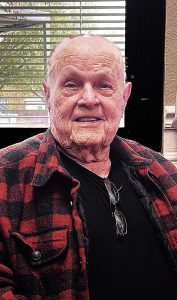
Guy Duke
At 99 years old, Guy Duke has witnessed nearly a century of American history, from the hardships of rural farm life during the Great Depression to the closing days of World War II and the remarkable changes that have shaped the nation in the decades since.
Now a resident of the Tennessee State Veterans Home in Humboldt, Duke is among a dwindling generation of Americans who can speak firsthand about their experiences serving their country during the Second World War. As Veterans Day approaches on Wednesday, Nov. 11, his recollections offer a glimpse into a pivotal period in American history and the experiences of the ordinary men called upon to serve during an extraordinary time.
Originally from rural West Tennessee near Lexington, Duke grew up in a farming family, where hard work and responsibility became familiar parts of his life at an early age. In fact, he remembers making the decision to help his father on the family farm when he was only 6½ years old.
“I was out playing. I had a little old car, and I was playing in the sand,” Duke recalled. “It hit me. My dad needed help.”
Recognizing that he was still too young to take on the responsibilities of farm work, Duke decided he would begin helping his father when he turned 9. He kept that promise, taking up the demanding work of plowing fields with a team of mules.
“I became a plow follower and broke ground every year with a team of mules and a plow,” he said.
Those early years instilled a work ethic that would serve Duke well when, at the age of 18, he found himself exchanging the familiar surroundings of his family’s farm for the uncertainty of military service. With World War II entering its final stages in 1945, American military planners were preparing for the possibility of a full-scale invasion of the Japanese mainland. Although Allied forces had achieved significant victories in the Pacific, the prospect of invading Japan itself raised fears of an exceptionally costly campaign.
Duke was among the young Americans called into service as the Army continued preparing for the possibility of prolonged fighting.
“Then I went to the Army at the age of 18 because they were getting desperate for men, especially if they was fixing to invade Japan,” he recalled.
His induction into military service coincided with what ordinarily would have been a milestone in his young life: his high school graduation.
“They took me out of high school on my day of graduation and carried me to Florida, made a soldier out of me, you know,” Duke said.
After being sent to Florida for military training, Duke received orders that would take him to Japan, where he expected to become part of the planned invasion force. However, the course of the war changed dramatically in August 1945. Following the atomic bombings of Hiroshima and Nagasaki, the Soviet Union’s entry into the war against Japan and Japan’s subsequent surrender, the anticipated invasion was canceled.
For Duke and countless other American servicemen preparing for the operation, the end of the war meant the possibility of returning home without having to participate in what could have been a devastating campaign. Duke remembers the relief he felt upon learning that the invasion would not take place.
“Oh it was a relief, definitely,” he said.
Although the fighting had ended, Duke’s military orders remained in effect. Rather than joining an invasion force, he traveled to Japan as part of the American military presence during the early occupation period, arriving in November 1945. There, the young soldier found himself facing a different set of challenges as the U.S. military undertook the immense task of scaling down its wartime operations.
Duke was assigned to the supply section of the 177th Engineer Construction Battalion, an organization he recalled had absorbed four other engineering construction battalions. Those units had been involved in the demanding logistical work of constructing roads, airfields, bridges and other infrastructure necessary to support military operations. The end of the war had left the Army with enormous quantities of equipment, vehicles and supplies scattered throughout the Pacific. Much of that material was no longer needed, and determining what to do with it became a major undertaking.
For Duke, who had entered the Army directly from high school and held the rank of private, the responsibility soon became considerably greater than he had expected. He recalled that in August, approximately nine months after his arrival in Japan, the captain overseeing his section received orders to return to the United States as part of the military’s ongoing demobilization. The captain’s departure left Duke with the responsibility of overseeing the disposition of substantial quantities of equipment belonging to five engineering battalions.
According to Duke, the equipment included bulldozers, road graders and machinery used for asphalt and concrete work, much of which had been brought from the Philippines in anticipation of the invasion of Japan. The government had determined that the equipment would not be returned to the United States. Instead, Duke said, it was to be transported to ships and disposed of at sea.
Duke recalled being allotted approximately one week to coordinate the operation, working with personnel assigned to each of the five battalions.
“I didn’t know anything. I was a buck private!” he laughed.
Fortunately, Duke found himself surrounded by more experienced soldiers who understood the equipment and the procedures necessary to complete the assignment.
“I was lucky because I had some pretty experienced men in these five different locations,” he said.
With their assistance, Duke coordinated the removal of the equipment within the allotted time. The assignment did not end there, however, as he was also responsible for helping clear the corresponding supply records and accounting for the disposition of the material. The administrative work brought its own complications, particularly when questions arose regarding the documentation necessary to account for the equipment. Nevertheless, Duke completed the responsibilities assigned to him.
“At the end of the three weeks, I was promoted from a buck private to sergeant,” he recalled. “It wasn’t much of a promotion, but it was okay.”
Duke said he also received a commendation for completing the assignment within the required time. For a young man who had been following a mule-drawn plow only a short time earlier, the experience represented a considerable change in responsibility.
As the Army continued sending servicemen home, Duke remained in Japan, helping supply the personnel who had not yet been discharged. His duties included traveling to military warehouses to obtain food and other provisions for the remaining soldiers. He continued that work until his own opportunity to return home finally arrived.
Although Duke’s military service took place during one of the most consequential conflicts in modern history, he is quick to acknowledge that his experiences differed from those of soldiers who fought on the front lines.
“That’s all there is to it, because I didn’t get in combat,” he said.
His account nevertheless illustrates the extensive work required of American servicemen even after the fighting had ended. The occupation and demobilization of Japan demanded the continued efforts of thousands of soldiers responsible for maintaining supplies, managing equipment and helping bring the American military’s wartime operations to a close. For Duke, the experience also marked the transition from the responsibilities of childhood to those of adulthood, placing him thousands of miles from his West Tennessee home at an age when many young men today are only beginning to consider their futures.
Once his military service ended, Duke returned to civilian life and pursued his education. He attended college in Martin, spending his first two years at what was then a junior college, the institution that eventually became the University of Tennessee at Martin.
After completing his studies, Duke entered the workforce, where one of his early assignments involved teaching agricultural subjects to farmers. Having spent much of his childhood working on the farm, Duke was no stranger to agriculture. Teaching it to others, however, proved to be a different matter. He recalled that some of the men attending his classes were more interested in receiving the financial benefits associated with the program than learning about farming, making the work less enjoyable than he had anticipated.
Although Duke’s military experience occupies an important place in his memories, he made it clear that the most meaningful part of his life came in the years that followed. He and his wife raised four children, and Duke said his responsibilities as a husband and father always took precedence over everything else.
“The family was always my number one priority,” he said.
Now, more than 80 years after the end of World War II, Duke is part of an increasingly small group of surviving American veterans who personally experienced the conflict and its immediate aftermath. Each passing year places greater historical significance on the memories of men like Duke, whose stories provide a direct connection to events that most Americans know only through history books, photographs and documentaries.
While the history of World War II is often told through the accounts of major battles, famous commanders and extraordinary acts of battlefield heroism, the experiences of soldiers like Duke offer another perspective. His military career was defined not by combat, but by the everyday responsibilities necessary to support the Army’s operations during the transition from war to peace.
His recollections also serve as a reminder of just how young many of the Americans who served during the war actually were. Duke was barely out of high school when he entered the military, yet within a relatively short time he found himself responsible for coordinating the disposition of valuable government equipment in a foreign country.
For many veterans of his generation, such responsibilities were simply part of what was expected of them.
As Americans observe Veterans Day, Duke’s story stands as a reminder that military service takes many forms, and that the contributions of those who served extend well beyond the battlefield. From a young boy working behind a team of mules in rural West Tennessee to a sergeant helping manage the aftermath of the largest war in human history, Duke has lived through a remarkable period of American lore.
Yet, despite the historical significance of his experiences, Duke recounts his service with considerable modesty, regarding the work he performed as simply the job he was assigned to do.